
Corporate governance system
Governance system and rationale for adopting this system
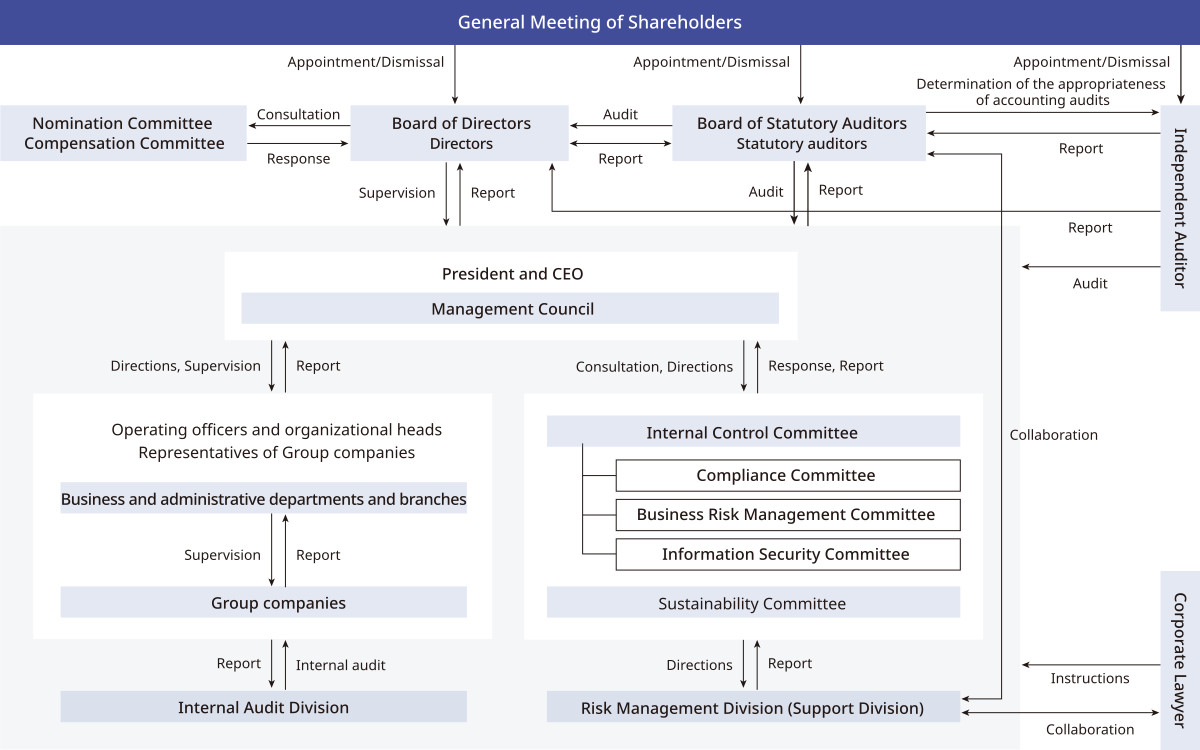
The Company has adopted a Company with Audit and Supervisory Board format, having determined this system to be the most conducive to ensuring appropriate corporate governance. Members of the Board of Statutory Auditors attend meetings of the Board of Directors and other important meetings in accordance with the audit policy and audit plan. They observe, from a perspective of fairness and impartiality, the execution of duties by the Board of Directors and audit the business and financial conditions of major offices and Group companies.
We have also adopted an operating officers system to separate the management decision-making and supervisory function from the business execution function, to achieve prompt and appropriate decision-making and business execution while further strengthening our corporate governance. The Board of Directors, chaired by the President and CEO, makes decisions on important matters and supervises business execution. Operating officers execute operations based on the Board of Directors’ decisions. Furthermore, in our Management Council we discuss important matters pertaining to business execution.
Simplified chart of corporate governance system
| Format | Company with Audit and Supervisory Board |
|---|---|
| Directors | 13 (including 5 outside directors) |
| Statutory auditors | 5 (including 3 outside statutory auditors) |
| Number of Board of Directors meetings held this fiscal year | 15 |
| Number of Board of Statutory Auditors meetings held this fiscal year | 16 |
| Operating officers system | Yes |
| Operating officers | 30 |
| Internal units of the Board of Directors | Nomination Committee and Compensation Committee |
| Number of Nomination Committee meetings held this fiscal year | 4 |
| Number of Compensation Committee meetings held this fiscal year | 4 |
Our corporate governance system (As of June 25, 2025)
Skills matrix of directors and statutory auditors
| Name | Corporate management & ESG | Innovation & DX | Engineering | Marketing & global business | Finance & accounting | Legal, human resources & labor relations | |
|---|---|---|---|---|---|---|---|
| Directors | Tetsuya Funabashi | ● | ● | ● | ● | ● | |
| Keigo Kajimura | ● | ● | ● | ● | ● | ||
| Noriyuki Watabe | ● | ● | |||||
| Fumitoshi Imaizumi | ● | ● | ● | ● | |||
| Shigeki Hayashi | ● | ● | ● | ||||
| Kouji Tanaka | ● | ● | ● | ● | |||
| Koichi Maeda | ● | ● | ● | ||||
| Masaki Kobayashi | ● | ● | ● | ● | |||
| Yasushi Kohara | ● | ● | |||||
| Naoko Iwasaki | ● | ● | ● | ||||
| Tatsushi Mochizuki | ● | ● | |||||
| Keiji Yoshida | ● | ● | ● | ● | |||
| Tomoko Aramaki | ● | ● | ● | ||||
| Statutory Auditors | Naruhiko Yamada | ● | ● | ● | |||
| Yuichi Koyama | ● | ● | ● | ||||
| Eiko Osawa | ● | ● | |||||
| Akira Harashima | ● | ● | ● | ||||
| Yukako Oshimi | ● | ● |
Note: These are the skills that each director and statutory auditor is particularly expected to have, and this table does not comprehensively indicate their entire skillsets.
Officers’ activities in FY2024
★Independent officers ◎Chair or committee chair
| Name | Board of Directors | Nomination Committee | Compensation Committee | Board of Statutory Auditors | |
|---|---|---|---|---|---|
| Directors | Tetsuya Funabashi | ◎ 100% (15/15) | - | - | - |
| Keigo Kajimura | 100% (11/11) | - | - | - | |
| Koichi Mino | 100% (15/15) | 100% (4/4) | - | - | |
| Noriyuki Watabe | 100% (15/15) | - | 100% (4/4) | - | |
| Yuichi Koyama | 100% (15/15) | - | 100% (4/4) | - | |
| Fumitoshi Imaizumi | 100% (15/15) | - | - | - | |
| Shigeki Hayashi | 100% (15/15) | 100% (4/4) | - | - | |
| Kouji Tanaka | 100% (11/11) | - | - | - | |
| Takafumi Sakaguchi | 100% (4/4) | - | - | - | |
| Yasushi Kohara ★ | 100% (15/15) | 100% (4/4) | ◎ 100% (4/4) | - | |
| Naoko Iwasaki ★ | 100% (15/15) | 100% (4/4) | - | - | |
| Tatsushi Mochizuki ★ | 100% (15/15) | ◎ 100% (4/4) | - | - | |
| Keiji Yoshida ★ | 100% (15/15) | - | 100% (4/4) | - | |
| Tomoko Aramaki ★ | 100% (15/15) | - | 100% (4/4) | - | |
| Statutory Auditors | Yasuo Otsubo | 100% (4/4) | - | - | 100% (5/5) |
| Shinji Kojima | 100% (15/15) | - | - | ◎ 100% (16/16) | |
| Naruhiko Yamada | 100% (11/11) | - | - | 100% (11/11) | |
| Shinnosuke Yamada ★ | 100% (4/4) | - | - | 100% (5/5) | |
| Kimiko Takahashi ★ | 100% (15/15) | - | - | 100% (16/16) | |
| Eiko Osawa ★ | 100% (15/15) | - | - | 100% (16/16) | |
| Akira Harashima ★ | 100% (11/11) | - | - | 100% (11/11) |
Note: Numbers in parentheses are times attended/number of meetings held during term as director. Discrepancies in number of meetings held are results of differences in time of appointment and/or leaving the position.
Transition to a stronger governance system
| Measure | Composition of the Board of Directors | Female directors | ||
|---|---|---|---|---|
| FY2024 | Strengthened initiatives to improve the effectiveness of the Board of Directors (e.g. site visits) |
8 inside 
5 outside 
|
13 in total | 2 |
| FY2023 | Increased the number of outside directors (from 4 to 5) Outside officers now chair both the Nomination Committee and Compensation Committee |
7 inside
5 outside
|
12 in total | 2 |
| FY2021 | Increased proportion of outside directors |
7 inside
4 outside
|
11 in total | 1 |
| FY2020 | Increased the number of outside directors (from 3 to 4) The majority of the members of the Nomination Committee and Compensation Committee are outside members |
8 inside
4 outside
|
12 in total | 1 |
| FY2018 | Increased the number of outside directors (from 2 to 3) |
12 inside
3 outside
|
15 in total | 1 |
| FY2015 | Increased the number of outside directors (from 1 to 2) Using a third-party organization, conducted a questionnaire for evaluating the effectiveness of the Board of Directors |
9 inside
2 outside
|
11 in total | 1 |
| FY2014 | Appointed an outside director (1) |
11 inside
1 outside
|
12 in total | 1 |
| FY2009 | Adopted an operating officers system |
8 inside
|
8 in total | 0 |
| FY2003 | Established Nomination Committee and Compensation Committee |
18 inside
|
18 in total | 0 |
Outside director
Nomination Committee and Compensation Committee
We have established a Nomination Committee and Compensation Committee comprised of directors including independent outside directors who were appointed in the Board of Directors, where we build common understanding on the evaluation criteria and compensation standards of each director and improve their supervisory function. Each committee is comprised of a majority of independent outside directors.
The Nomination Committee engages in activities with the objective of strengthening corporate governance by ensuring the objectivity, timeliness, and transparency of officer
personnel-related matters.
The Compensation Committee engages in activities with the objective of strengthening corporate governance by ensuring the objectivity and fairness of the compensation and other conditions of officers. The Compensation Committee for fiscal 2024 referred to research materials from outside institutions and trends at other companies to review officer remuneration and proportions of remuneration, and held discussions accordingly. They also proceeded with considerations for awarding stock-based compensation to Group companies and provided a report in a Board of Directors meeting.
Meetings in FY2024
| Nomination Committee | 3 meetings |
|---|---|
| Compensation Committee | 4 meetings |
-
Composition of the Nomination Committee for FY2025
Committee chairman Committee members
Mochizuki
Hayashi
Kobayashi
Kohara
Iwasaki Outside director(honorifics omitted)
-
Composition of the Compensation Committee for FY2025
Committee chairman Committee members
Kohara
Watabe
Maeda
Yoshida
Aramaki Outside director(honorifics omitted)
Audit system
Board of Statutory Auditors
The Board of Statutory Auditors considers auditing policies, audit plans, and business management from the sustainability perspective, the development and operational status of internal control systems, the appropriateness of accounting audits, and agreements on the evaluations and compensation of accounting auditors. Additionally, this board receives detailed explanations from the Finance Department and independent auditors hold lively discussions, and express opinions about key audit matters(KAMs). For statutory auditor audits, they conduct audits according to the auditing policy and audit plan in compliance with the statutory auditor audit standards determined by the Board of Statutory Auditors. Specifically, they attend important meetings such as the Board of Directors, audit the proceedings and resolutions, and express opinions when necessary. Aside from that, they conducted 70 interviews (hybrid of face-to-face and web conferences) and field visits with the representative director, Head Office executives, main business locations, and subsidiaries.
In the interviews and field visits, aside from auditing business operations and financial conditions they also exchanged opinions about matters such as DX implementation initiatives, operational structures according to area characteristics, unified R&D efforts as a Group, securing and developing personnel from the perspective of human capital, and employee health and safety.
Standing statutory auditors report to the Board of Statutory Auditors on the results of their active communication and information sharing with related departments on important decision-related documents viewed, deliberations in the Management Council, and on the various issues. In everyday auditing activities, they gather information internally to comprehend the issues in our business groups and share information and opinions with outside statutory auditors in a timely manner. Outside statutory auditors express opinions from broad perspectives in the Board of Directors and Board of Statutory Auditors based on their extensive range of work experience and high-level expertise. Exchanging opinions also with the President and CEO, they receive explanations of management policies and leverage their expertise and experience to express their opinions from an outside perspective.
In fiscal 2024, outside directors and outside statutory auditors observed worksites, visited business locations, and exchanged opinions with general managers and younger executive-class personnel to gain a deeper understanding of the business. Three outside statutory auditors participated in these activities.
Accounting auditor
On the presumption of a high level of independence, advanced expertise, and appropriate systems for quality control, our Board of Statutory Auditors has determined that Grant Thornton Taiyo LLC is suitable to serve as our accounting auditor, having comprehensively considered their group auditing system established based on an understanding of the business fields in which we operate, their auditor compensation levels being appropriate, and also the global audit system they have constructed, based on policies for determination of dismissal of or refusal to reelect accounting auditors and also evaluation and selection criteria for financial auditors.
| Name of auditing firm | Grant Thornton Taiyo LLC |
|---|---|
| Continuous audit period | 4 years |
| Certified Public Accountants who have executed operations for the Group |
Tatsuya Arai, Certified Public Accountant, Managing Partner, Designated Limited Liability Partner Daishi Nishimura, Certified Public Accountant, Managing Partner, Designated Limited Liability Partner Koki Otsuka, Certified Public Accountant, Managing Partner, Designated Limited Liability Partner |
| Those with supporting roles for audit operations |
Certified public accountants: 20 Other supporters: 19 |
Internal audit status
The Internal Audit Division and internal audit departments at each Group company coordinate together to audit the appropriateness of our business operations and those of our subsidiaries, and to audit the preparation and operation status of internal control systems, including internal controls related to financial reporting. For the results of internal audits, we employ a dual reporting system in which the Internal Audit Division reports directly to our Board of Directors and Management Council, and on a quarterly basis to the Compliance Committee also attended by standing statutory auditors.
We also report internal audit plans, main internal audit results, and the status of improvement measures to our accounting auditor. We are also regularly reporting internal audit results and the status of improvement measures to statutory auditors, and we facilitate their mutual cooperation. In addition, we receive guidance and advice from legal experts.
Evaluating the effectiveness of the Board of Directors
To enhance the function of the Board of Directors and business value, we evaluate the effectiveness of our Board of Directors based on the results of questionnaire surveys among all Directors and Statutory Auditors, which are collected and analyzed by an external organization to ensure objectivity.
Based on the results of the analysis and discussion among the Board of Directors, it was confirmed that our Board of Directors has adequate scale and structure and is appropriately operated to ensure proper decision-making on important management agendas and supervision of business execution. As part of our efforts to strengthen our governance, we are working to increase our ratio of female officers. Since June 2023, we have one additional female independent outside director. Now with two independent outside female directors and two independent outside female statutory auditors for a total of four, women hold 22% of our officer roles.
In addition, we continued to distribute Board of Directors’ meeting materials as early as possible, to enhance the explanations that we provide in advance to independent outside directors and independent outside statutory auditors, and to arrange for site visits by independent outside directors. During fiscal 2024 we also conducted “Vector Meetings” for 26 projects, in which all business units get together at earlier stages to discuss business strategies and build common ground. The Sustainability Committee also holds sufficient discussions on initiatives to improve sustainability such as ESG and the SDGs, and reports to the Board of Directors on a regular basis. Outside directors and outside statutory auditors actively make valid remarks from an independent standpoint grounded on sufficient insight in discussions at meetings of the Board of Directors. We see the undeniable effects of these efforts in the strengthened effectiveness of the Board of Directors.
Going forward, based on these results of Board of Directors effectiveness evaluations and opinions, the Company’s Board of Directors will fully consider measures for improving its effectiveness and continue to implement initiatives for enhancing its functions.
Board of Directors evaluation process

Efforts in FY2025 to further improve effectiveness
| Topic | Description | Actions in FY2025 |
|---|---|---|
| Composition of the Board of Directors | Ratio of female officers Need for non-Japanese officers Developing and promoting officers from cultivated talent |
|
| Operation of the Board of Directors and discussions therein | Securing time for discussion and deliberation |
|
| Other | Assistance for making appropriate decisions |
|
State of enhanced monitoring based on effectiveness evaluations
| Topic | Main discussions in Board of Directors meetings |
|---|---|
| Real estate investment plan | Reports regarding execution status of acquisition and sale transactions and refurbishment plans are provided. As the progress against plans are verified, concerns about individual cases are also shared. Regarding sales transactions, bundling harder-to-sell properties with highly marketable ones were considered. |
| System investment plans |
In addition to sharing the status of IT budget use, progress reports regarding the following initiatives were provided: System renewals and rollouts to Group companies, building communication platforms for Group utilization, security monitoring and operations service offerings, improvements on the quality of the Group network, and the construction of the Iwatsuki Data Center. |
| M&A investment plans | The progress of high-probability transactions in the Group’s M&A investment plan is monitored. Concurrently, the progress of post-merger integration (PMI) for completed M&A transactions is also shared, and the Board engages in discussions regarding the full M&A process from a broader perspective. |
| R&D investment plans |
Implementation status of corporate initiatives and support initiatives selected as subjects for R&D is reported. Discussions also include R&D management improvements focusing on group collaboration, appropriate accounting practices, and intellectual property monetization. |
| Workforce plan |
The progress of hiring plans for Group companies and the Exeo Group is analyzed by segment and by company. Discussions also cover the effectiveness of various hiring methods, such as strengthening referral hiring, non-citizen hiring, converting temporary employees to permanent positions, and direct recruiting. |
| Training plan | Progress on various key initiatives such as the Transformation Leader Development Program, and 1-on-1 meeting training for managers, aimed at promoting higher employee engagement and ensuring psychological safety. |
Director appointment, composition, and development of successors
Desired qualities and appointment process
Our method for choosing candidates for directors is to hold deliberations in the Nomination Committee, an internal unit of the Board, on those with excellent character and insight, strong moral character, the energy to drive transformation, leadership skills, and the ability to make accurate decisions. The representative director then gives recommendations, suitability of the candidates is deliberated in the Board of Directors, after which offers are made and motions sent to the General Meeting of Shareholders. Appointments and dismissals of representative directors and executive directors are decided in the Board of Directors.
If there is a director who should be dismissed, the Board of Directors raises a motion for dismissal of the director in the General Meeting of Shareholders. To choose candidates for statutory auditors, the representative director recommends those with business management experience, expertise in finance and accounting, and the high-level insight needed to fulfill the role of a statutory auditor. Motions are then sent to the General Meeting of Shareholders after approval by the Board of Statutory Auditors.
Composition of the Board of Directors
We are committed to improving the activity level and governance of our Board of Directors by ensuring balance and diversity among their backgrounds areas of expertise.
Based on the belief that our number of directors can enable us to swiftly and accurately accommodate drastically changing business environments, we employ an operating officers system in order to further accelerate our decision-making.
Successor planning
We promote and attract management personnel from the outside in addition to internally. From among these personnel, our representative director identifies individuals who deeply understand our Group philosophy and management vision, have high ethical standards, leadership qualities, and the capability to drive the ongoing growth of the Group, and selects them as successors. Decisions on these successors are then made after deliberation in the Nomination Committee and Board of Directors.
Use of outside directors and statutory auditors
The Company has five outside directors and three outside statutory auditors. The functions and roles that outside directors and outside statutory auditors should carry out in the corporate governance of the Company are as follows. Outside directors should fulfill the function of supervising and monitoring the management of the Company from an independent and neutral standpoint, providing comments based on their abundant experience and wide-ranging knowledge. Outside statutory auditors should fulfill the management monitoring function by auditing from an objective standpoint, offering a perspective informed by advanced expertise, abundant experience, and wide-ranging knowledge. Regarding the criteria or policies concerning independence for appointing outside directors or outside statutory auditors, the Company secures independent directors and statutory auditors in accordance with Article 436-2 and Article 445-4 of the Securities Listing Regulations of Tokyo Stock Exchange, Inc., and the criteria for determining independence stipulated by the same exchange (“Guidelines for Listing Management, etc.”).
To facilitate better Board of Directors meetings, the Company distributes Board of Directors’ meeting materials to outside directors early on, and provides them advance explanations on the backgrounds, objectives, and details of proposals for Board of Directors agenda items.
Reasons for selection of outside directors and statutory auditors
| Job title | Name | Year appointed | Reasons for selection |
|---|---|---|---|
| Director | Yasushi Kohara | 2018 | Having gained deep experience and insight in corporate management at the Toyota Group, Mr. Kohara has provided appropriate advice and recommendations in important management decisions of the Company, appropriately fulfilling his role as an outside director. |
| Naoko Iwasaki | 2019 | Ms. Iwasaki is a leading international researcher and expert on digitalization in international relations, national and local government administration, disaster countermeasures and BCP, aging society, and women’s career advancement. She has provided appropriate advice and recommendations in important management decisions of the Company, appropriately fulfilling her role as an outside director. | |
| Tatsushi Mochizuki | 2020 | Mr. Mochizuki has been involved in key positions in central government ministries and local governments for many years. With the insight he has accumulated through his career, he has provided appropriate advice and recommendations in important management decisions of the Company, appropriately fulfilling his role as an outside director. | |
| Keiji Yoshida | 2021 | Mr. Yoshida has a wealth of experience and insight in corporate management as an officer of JFE Engineering Corporation and other companies. He has provided appropriate advice and recommendations in important management decisions of the Company, appropriately fulfilling his role as an outside director. | |
| Tomoko Aramaki | 2023 | Possessing a wealth of experience and expertise in finance and accounting as a CPA and tax accountant and insight in business management, Ms. Aramaki has provided appropriate advice and recommendations in important management decisions of the Company. She is appropriately fulfilling her role as an outside director. | |
| Statutory auditor | Eiko Osawa | 2023 | Possessing a wealth of global experience and expertise in finance and accounting as a CPA at a major auditing firm, Ms. Osawa has been auditing the business execution of directors from an independent standpoint while also appropriately fulfilling her role as an outside statutory auditor. |
| Akira Harashima | 2024 | Possessing a wealth of experience and outstanding knowledge in business management, including in global business as an officer at Tokio Marine Holdings, Inc., Mr. Harashima has been auditing the business execution of directors from an independent standpoint while also appropriately fulfilling his role as an outside statutory auditor. | |
| Yukako Oshimi | 2025 | Ms. Oshimi has abundant experience and expertise in law as an attorney at law, has served as a Director and Audit & Supervisory Board Member at listed companies, and the Company believes that she will appropriately perform her duties as Audit & Supervisory Board Member. The Company has therefore nominated her as candidate for Outside Audit & Supervisory Board Member. |